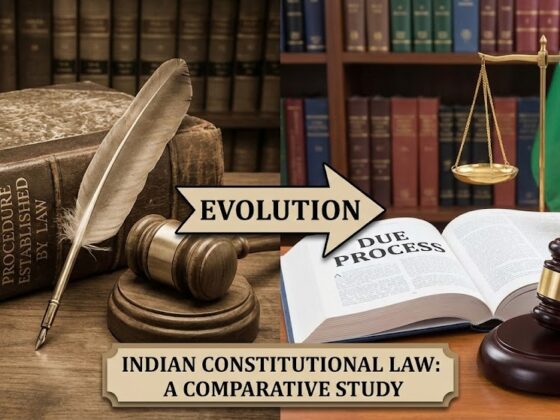
The term “natural justice” originates from the Roman law expression Jus Naturale, which translates to the “law of nature.” While it does not always hold the force of a formal statute, it represents a foundational concept of common law that must be followed. Adherence to these principles is essential not only when a quasi-judicial body determines disputes between parties, but also whenever administrative actions involve civil consequences or judicial discretion is exercised.
What Is Natural Justice?
Natural justice implies fairness, reasonableness, equity, and equality. It is used interchangeably with terms like Divine Law, Jus Gentium (the law of nations), and the Common Law of Nations. Essentially, natural justice constitutes the core of fair adjudication; it is deeply rooted in tradition and conscience and is considered a fundamental human requirement. The primary purpose of following these principles is the prevention of the miscarriage of justice.
In a welfare state like India, the jurisdiction of administrative agencies is expanding rapidly. The concept of the “Rule of Law” would lose its validity if the instrumentality of the state were not required to discharge their functions in a fair and just manner.
Constitutional Basis of Principles of Natural Justice
Although the principles of natural justice are not explicitly stated in the Indian Constitution, they are deeply embedded through judicial interpretation of fundamental rights, specifically Articles 14 and 21, which ensure fairness in administrative and quasi-judicial actions.
Article 14 (Equality)
Article 14 guarantees equality before the law and equal protection. This has been interpreted to strike down not only discriminatory class legislation but also arbitrary state action. Because the violation of natural justice results in arbitrariness, such a violation is inherently a breach of the equality clause of Article 14.
Article 21 (Life and Liberty)
With the introduction of the concepts of substantive and procedural due process in Article 21 cemented by the Maneka Gandhi v. Union of India (1978) judgment the fairness inherent in the principles of natural justice is now read into Article 21. Before this landmark case, the court had a narrower view of procedural law. Post-Maneka Gandhi, the Supreme Court ruled that any procedure that deprives a person of their life or personal liberty must not be arbitrary, fanciful, or oppressive; it must be “right, just, and fair.” This shifted the focus from merely having a law in place to ensuring that the law itself passes the test of reasonableness.
Two Main Principles of Natural Justice
There are two primary pillars of natural justice:
- Nemo debet esse judex in propria causa (The Rule Against Bias).
- Audi alteram partem (The Right to a Fair Hearing).
Nemo Debet Esse Judex in Propria Causa
This principle of impartiality roughly translates to: “Nobody shall be a judge in their own cause, or in a cause in which they have an interest.” This is popularly known as the Doctrine of Bias. To instill public confidence in the legal system, justice should not merely be done; it must be seen to be done.
The Rule Against Bias
At the heart of administrative justice lies the requirement that the decision-maker must be impartial. The “Rule Against Bias” ensures that authorities reach conclusions based solely on objective evidence, rather than personal prejudice.
Real-World Application: Consider a scenario where a municipal planning committee is deciding whether to grant a construction permit for a new shopping mall. If the chairperson of that committee owns a significant number of shares in the construction firm applying for the permit, a “pecuniary bias” exists. Even if the chairperson acts with complete integrity, the mere existence of a financial stake creates a “reasonable suspicion” of bias, which could render the committee’s decision invalid in a court of law.
The Four Main Pillars of Bias
Bias can take several distinct forms that undermine the fairness of a proceeding:
- Personal Bias: Stems from relationships, whether hostile or friendly, between the judge and the parties. To challenge this, one must prove a “real likelihood” or “reasonable suspicion” of bias, not mere conjecture.
- Pecuniary Bias: Relates to financial interest. Even the smallest financial stake in the outcome will typically disqualify a person from acting as a decision-maker.
- Subject Matter Bias: Occurs when the adjudicator has a direct involvement in the specific issue being debated.
- Departmental Bias: A common challenge in administration, arising when a department acts as both prosecutor and judge, or when duty conflicts with departmental loyalty.
Audi Alteram Partem
The principle of Audi alteram partem literally “hear the other side” is more than a procedural formality; it is a fundamental pillar of natural justice. It ensures that no individual is condemned unheard. To ensure an “effective hearing,” authorities must adhere to several procedural requirements:
1. The Necessity of Notice
A fair hearing begins with notice that is precise, unambiguous, and timely.
- Mandatory Disclosure: Authorities must disclose all material and evidence relied upon for the proposed action.
- Alignment with Charges: A party cannot be penalized based on charges different from those specified in the original notice.
- Return of Documents: Unrelied-upon documents seized during an investigation must be returned within a reasonable timeframe.
2. The Right to Represent and Be Heard
The opportunity to respond must be substantive, not a “make-believe” exercise.
- Time and Personal Hearing: Parties must be granted sufficient time to prepare a defense.
- The “Heard-by-the-Same-Officer” Rule: As a general rule, the officer who hears the arguments should be the one to pass the order.
- Avoid “Batch” Scheduling: Issuing a single notice with multiple, pre-fixed hearing dates is considered a violation.
3. The Power of Cross-Examination
A critical component of Audi alteram partem is the right to cross-examine witnesses. While the denial of this right generally constitutes a violation, it is not absolute. Exceptions exist for protecting the identity of informers, cases with sufficient documentary evidence, or where logistical costs are disproportionate.
4. Legal Representation
Fairness dictates equality in representation. If one party is assisted by legal counsel, the opposing party must not be denied similar access to legal representation.
Exceptions to the Principles of Natural Justice
While foundational, these principles are not absolute. They can be excluded by statute or necessary implication, provided they remain subject to the safeguards of Articles 14 and 21. Key exceptions include:
- Emergency Situations: In cases requiring prompt preventive action (e.g., demolishing a dangerous building).
- Confidentiality: If disclosure would defeat the purpose of the action (e.g., police surveillance).
- Routine Academic Matters: Evaluating performance or disciplining students for minor procedural violations.
- Administrative Impracticability: When an issue is of such scale that providing a hearing to all affected parties is impossible.
- Interim Preventive Action: Actions taken to maintain order (e.g., suspending a student pending investigation).
- Legislative Actions: Because legislative acts establish broad policy rather than targeting individuals.
- No Infringement of Rights: If no legal right has been conferred upon an individual.
- Doctrine of Necessity: Where an official is the only person competent to decide a matter.
- Contractual Arrangements: Termination of purely contractual agreements is generally not considered an administrative act.
Conclusion
In conclusion, the principles of natural justice serve as the essential bedrock for the legitimacy and moral authority of any administrative or judicial system. By mandating impartiality through the “Rule Against Bias” and guaranteeing the right to be heard via Audi alteram partem, these principles transform the exercise of state power into a transparent, equitable process. They function as a vital constitutional safeguard, ensuring that discretion is never synonymous with arbitrariness and that the rights of individuals are protected against the potential overreach of administrative agencies.