Imagine waking up to find your bank account frozen, your property seized, or your freedom restricted. No explanation, no hearing, and no chance to defend yourself. In a constitutional democracy, the “Due Process of Law” doctrine prevents this nightmare.
This article explains “due process of law,” “procedure established by law,” their differences, and their application in India.
What is Due Process of Law?
The American legal system recognizes this doctrine. The 5th Amendment to the US Constitution laid that person’s life, liberty or property would not be deprived without due process of law1.
The Due Process of Law Doctrine ensures that the government, while making a law, must respect the principles of natural justice and if the procedure laid down by the legislature encroaches upon the personal life and liberty of an individual, then it must be fair, just, reasonable and free from arbitrariness.
The two facets of Due Process of Law:
- Procedural Due Process– The due process of law ensures that the procedure legislated must not be arbitrary. This ensures that the method or procedure the government follows is fair. For example, before depriving someone of life, liberty, or property, the government must provide:
- Notice
- A fair hearing
- An impartial decision maker
- Opportunity to present evidence
- Substantive Due Process– It examines whether the law itself is fair and reasonable. Even if proper procedure is followed, the Court can invalidate a law if it unjustifiably interferes with the Liberty and Fundamental Rights of citizens. For example, court can scrutinize whether the law dealing in preventive detention is fair, just and reasonable.
Procedure Established by law
The Constitution of India enshrines the doctrine of Procedure established by law under Article 21 and states that “No one shall be deprived of his life or personal liberty unless in accordance with the procedure established by law.“2
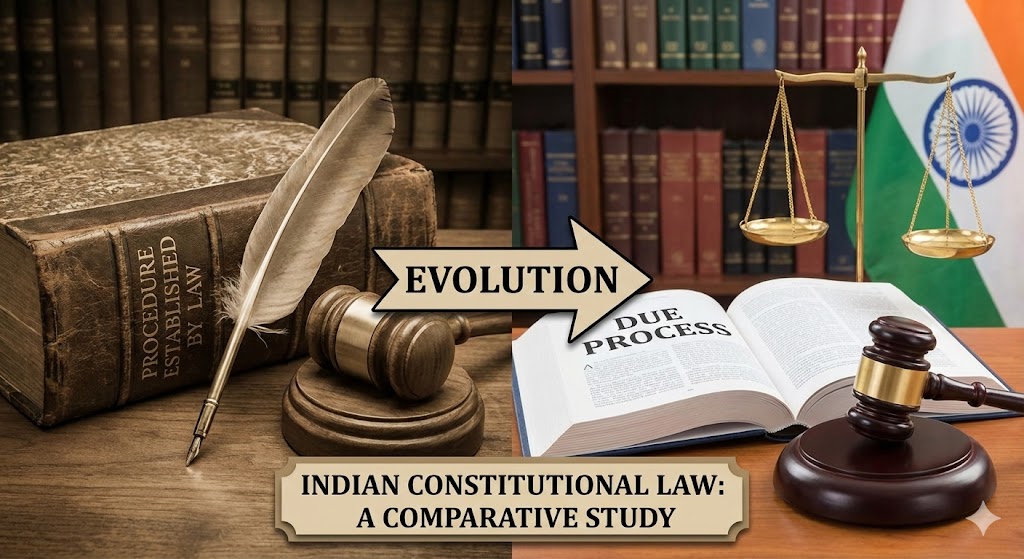
This doctrine is narrower than the doctrine of Due Process of law. The expression “procedure established by law” means procedure laid down by statute or procedure prescribed by the law of the state.3 It implies that if the procedure enshrined in the law has been followed properly, then a person can be deprived of his life or personal liberty irrespective of the arbitrariness or unfairness of the procedure.
Evolution of Procedure Established by Law in India
Initially, India strictly interpreted this doctrine. In the A.K. Gopalan case (1950)4, the Supreme Court ruled that “procedure established by law” was not synonymous with “due process.” The Court held that the Constituent Assembly deliberately chose the narrower term. In this case a writ petition was filed before the Hon’ble Supreme Court claiming that the Preventive Detention Act, 1950 is unconstitutional as it violates Article 19(1) (d) which is right to move freely throughout the territory of India and Article 21.
It was held by the majority that the “procedure established by law” mentioned in Article 21 is not synonymous with “due process of law”. In the court’s view, the constituent assembly deliberately adopted the doctrine of procedure established by law and giving a wider interpretation to Article 21 was outside the purview of the court.
A shift began with R.C. Cooper v. Union of India (1970)5 (Bank Nationalization case), where an 11-judge Bench held that Fundamental Rights are not mutually exclusive. The Court clarified that a valid law must fall within legislative competence and must not violate rights under Part III. This broadened the interpretation of Article 21, allowing laws infringing fundamental rights to be struck down.
The narrow approach in A.K. Gopalan was overruled in Maneka Gandhi v. Union of India (1978)6. In this case, the government impounded Maneka Gandhi’s passport under Section 10(3)(c) of the Passport Act, 1967 in ‘public interest’ without furnishing reasons, prompting her to challenge the action before the Supreme Court.
A 7-judge Bench held that the ‘procedure’ under Article 21 must be just, fair, and reasonable, not arbitrary or oppressive. The Court affirmed that Articles 14, 19, and 21 are interconnected and not watertight compartments, endorsing the reasoning in R.C. Cooper. This landmark ruling gave Article 21 its broadest interpretation and effectively introduced the doctrine of due process into Indian constitutional law. Any restriction on rights under Article 21 must also meet the tests of fairness and reasonableness under Articles 14 and 19.
Conclusion
The journey of Article 21 from A.K. Gopalan to Maneka Gandhi reflects a significant transformation in the understanding of personal liberty in India. While the framers of the Constitution initially chose the specific language of “procedure established by law” to avoid judicial interference, the Supreme Court eventually recognized that procedural adherence is hollow without substantive fairness. Today, the distinction between these two doctrines has largely blurred in India. By requiring that every law be “just, fair, and reasonable,” the Indian courts have effectively woven the American concept of Due Process into the fabric of our own Constitution, ensuring that the nightmare of arbitrary state action remains a thing of the past.
- U.S. Const. amend. V.https://constitution.congress.gov/constitution/amendment-5/ ↩︎
- Ind. Const. art. XXIhttps://www.legislative.gov.in/static/uploads/2025/07/ca7ce5c746fa7480804bbdeb6cb704f0.pdf ↩︎
- V.N Shukla, Constitution of India (12th ed. 2013). ↩︎
- MANU/SC/0012/1950 ↩︎
- MANU/SC/0011/1970. ↩︎
- MANU/SC/0133/1978. ↩︎