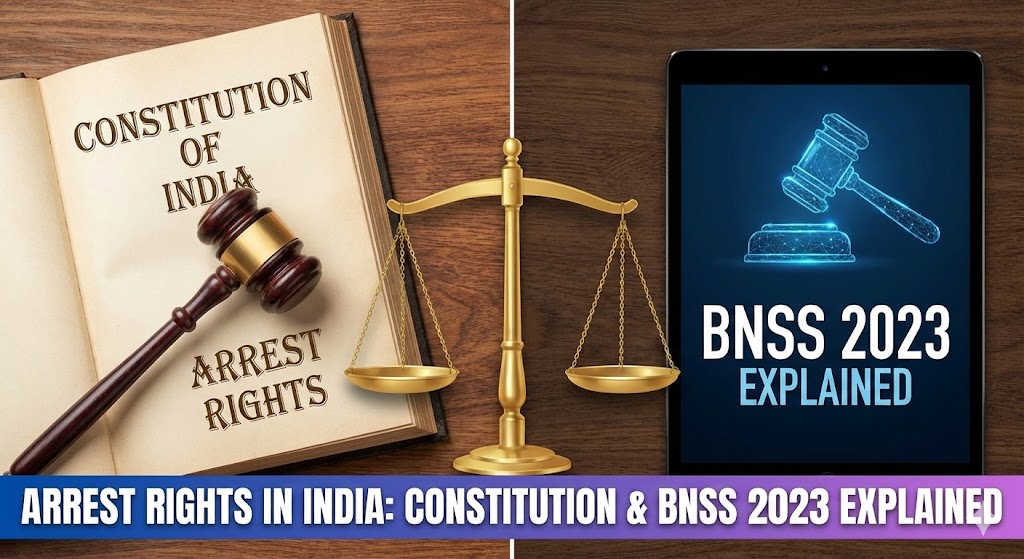
One of the most frightening experiences for a common person is an arrest. Understanding your rights during arrest in India is the first step toward ensuring justice.
Indian law does not give unlimited power to the police. The Constitution, the Bharatiya Nagarik Suraksha Sanhita (BNSS) 2023, and judgments of the Hon’ble Supreme Court clearly protect citizens from arbitrary arrest and abuse of power. This blog aims to explain the rights of a person at the time of arrest, so every citizen can stand informed and confident.
1. Right to Know the Grounds of Arrest
(Article 22(1) of the Constitution & Section 47 of the BNSS.)
No person can be taken into custody without being informed of the specific reason for their arrest. This must be provided:
- In writing.
- In a language the person understands.
As established in Mihir Rajesh Shah v. State of Maharashtra (2025) and Vihaan Kumar v. State of Haryana (2025), the police must clearly state the specific offense and grounds; failure to do so renders the arrest illegal. In bailable offenses, police are also duty-bound to inform you of your right to bail immediately.
2. Right to Legal Counsel and Free Legal Aid
(Article 22(1) of the Constitution & Sections 340-341 of the BNSS.)
Every arrested person has a fundamental right to consult and be defended by a legal practitioner of their choice (Mohd. Ajmal Amir Kasab v. State of Maharashtra, 2012).
- Interrogation: Police must facilitate access to a lawyer at reasonable intervals during questioning.
- Legal Aid: Under Article 39A, if a person cannot afford a lawyer, the state is mandated to provide free legal aid.
3. Right to Inform a Relative or Friend
(Section 48 of the BNSS & D.K. Basu v. State of West Bengal (1997).)
You have the right to nominate one friend, relative, or well-wisher to be informed of your arrest and the location of your detention.
- The police must record this information in the station diary.
- Notification must occur within 12 hours of the arrest.
- Secret detention is strictly unconstitutional.
4. Right Against Illegal Detention (The 24-Hour Rule)
(Article 22(2) of the Constitution & Section 58 of the BNSS.)
An arrested person must be produced before the nearest Magistrate within 24 hours (excluding the time necessary for travel). No person can be detained in custody beyond this period without a specific judicial order. As held in Joginder Kumar v. State of U.P. (1994), any violation of this rule is a serious breach of personal liberty.
5. Right to Medical Examination
(Sections 52-53 of the BNSS.)
To prevent custodial violence, you have the right to demand a medical examination by a registered practitioner.
- This documents existing injuries at the time of arrest.
- Examinations should be repeated every 48 hours while in custody.
- For Women: The examination must be conducted by or under the supervision of a female medical practitioner.
6. Special Safeguards for Women
(Section 43(5) of the BNSS & D.K. Basu Guidelines.)
The law provides specific protections to safeguard the dignity and privacy of women:
- Female Officers: Arrests of women must be carried out by female police officers.
- Time Restraint: Arrests should ideally take place between 6 AM and 6 PM. Arrests after sunset or before sunrise require exceptional circumstances and prior judicial permission.
7. Right to Silence and Protection Against Self-Incrimination
(Article 20(3) of the Constitution.)
You cannot be compelled to be a witness against yourself. Forced confessions are inadmissible in court unless made voluntarily before a Magistrate (Nandini Satpathy v. P.L. Dani, 1978). You have the right to remain silent during interrogation to avoid self-incrimination.
8. Arrest is Not Mandatory: The “Notice of Appearance”
(Sections 35, 36 & 172 of the BNSS.)
For offenses punishable by up to 7 years of imprisonment, arrest is not automatic. According to the Arnesh Kumar v. State of Bihar (2014) principles, police should typically issue a Notice of Appearance unless there is a risk of:
- Absconding.
- Evidence tampering.
- Threatening witnesses.
9. The Right to Bail: “Bail, Not Jail”
The foundational principle of Indian criminal jurisprudence remains that bail is the rule and jail is the exception.
| Offense Category | Right to Bail |
| Bailable Offenses | Bail is a statutory right; the police/court must grant it. |
| Non-Bailable Offenses | Bail is discretionary but must be exercised judiciously, not mechanically. |
Supreme Court Authority:
- Sanjay Chandra v. CBI (2012) 1 SCC 40
- Satender Kumar Antil v. CBI (2022) 10 SCC 51
Arbitrary denial of bail can be challenged before higher courts.
Awareness Is the First Line of Defence
The power of arrest is meant to uphold the rule of law—not to suppress liberty or dignity. Awareness of constitutional rights and statutory safeguards under the BNSS empowers citizens to protect themselves against misuse of authority.
In the event of arrest:
- Remain calm;
- Assert your rights respectfully; and
- Seek immediate legal assistance.
Remember:
Assertion of rights is not defiance, it is the exercise of constitutional liberty.
Disclaimer: This blog is for legal awareness only and does not substitute professional legal advice. Facts of each case differ.