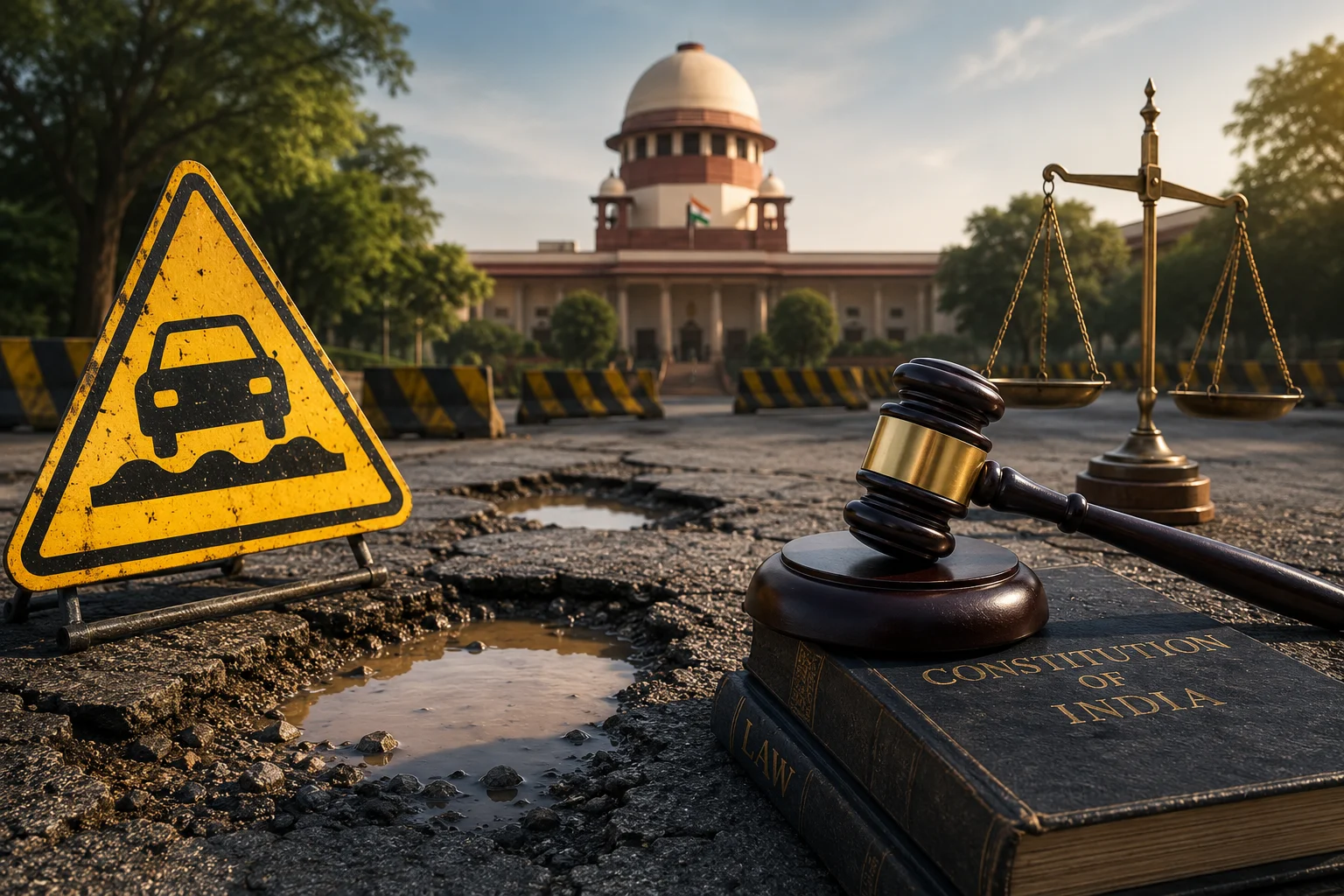
For decades, road accidents in India have been treated through a narrow legal lens: a combination of criminal prosecution for “rash and negligent driving” under penal laws and civil battles for insurance payouts before Motor Accident Claims Tribunals (MACT). When a tragedy occurred, the legal script almost exclusively blamed human error.
However, a revolutionary constitutional shift has fundamentally rewritten this script. In a landmark suo motu judgment, In re: Phalodi Accident v. National Highways Authority of India & Others (2026 INSC 388), the Supreme Court of India elevated road safety from a mere administrative policy goal to an enforceable Fundamental Right under Article 21 of the Constitution.
For the first time, the apex court has cleared the path for a powerful legal question: Can citizens hold the State constitutionally liable for systemic negligence and catastrophic infrastructure failures that led to road accidents?
The Constitutional Shift: From Negative Protection to Positive Mandate
The Division Bench, comprising Justices J.K. Maheshwari and Atul S. Chandurkar, expanded the horizon of Article 21 (The Right to Life and Personal Liberty), marking the true significance of the Phalodi Accident judgment.
Historically, Article 21 acted as a shield protecting citizens from the arbitrary or unlawful taking of life by the State. In this ruling, the Supreme Court transformed it into a positive obligation:
“The Right to Life enshrined under Article 21 of the Constitution is not merely a guarantee against the unlawful taking of life, but a positive mandate upon the State to ensure a safe environment where human life is preserved and valued.” 0
The Court recognized commuter safety as a vital component of the right to live with dignity, determining that high-speed National Highways and Expressways must not be permitted to turn into hazardous zones because of administrative negligence. Most significantly, the Bench held that the government cannot use administrative hurdles or financial limitations as an excuse to justify failing this protective duty.
The Court’s Diagnosis of India’s Road Crisis
The judgment fundamentally challenges the long-standing legal fiction that drivers are solely to blame for highway fatalities. Drawing on data from the Ministry of Road Transport and Highways (MoRTH), the Court highlighted a striking systemic imbalance: National Highways constitute roughly 2% of India’s total road network, yet they account for over 30% of all road fatalities.
Instead of dismissing these statistics as unavoidable bi-products of high-speed travel, the Supreme Court systematically cataloged the non-driver, infrastructural, and administrative causes behind India’s major accidents:
1. Structural and Engineering Failures
-
- Persistent Hazardous Zones (Blackspots): The continued existence of flawed road architecture, including unsafe entry/exit points, non-scientific designs, and elevated medians lacking pedestrian infrastructure, which effectively transform particular highway segments into inevitable locations for fatal accidents.
-
- Deficiencies in Passive Safety: This involves a critical shortage of scientifically-backed signage, irregular road surfaces, improperly designed speed breakers, and crash barriers that are either compromised or entirely absent.
-
- Inadequate Illumination: Critical shortages in lighting infrastructure across high-speed corridors, which effectively blind drivers to unexpected obstacles.
2. Administrative and Enforcement Lapses
-
- Unregulated and Unlawful Shoulder Obstruction: The widespread occurrence of heavy and commercial vehicles parking unlawfully on paved shoulders, necessitated by the total absence of authorized truck stops and roadside facilities.
-
- Encroachments for Commercial Use: The proliferation of unregulated dhabas, roadside eateries, and unauthorized structures within highway safety zones. These developments obstruct visibility by creating major blind spots and significantly impede the orderly flow of traffic.
-
- Administrative Fragmentation: There is a total lack of a centralized, responsible body to oversee operations. Efficiency in safety management is frequently undermined by poor cooperation between infrastructure agencies, including the NHAI and PWD, and regulatory entities like the Transport Departments and State Police.
Your Legal Rights as a Citizen
By shifting the issue from standard motor vehicle law to constitutional law, the Supreme Court has opened up distinct pathways for establishing legal liability when an accident occurs.
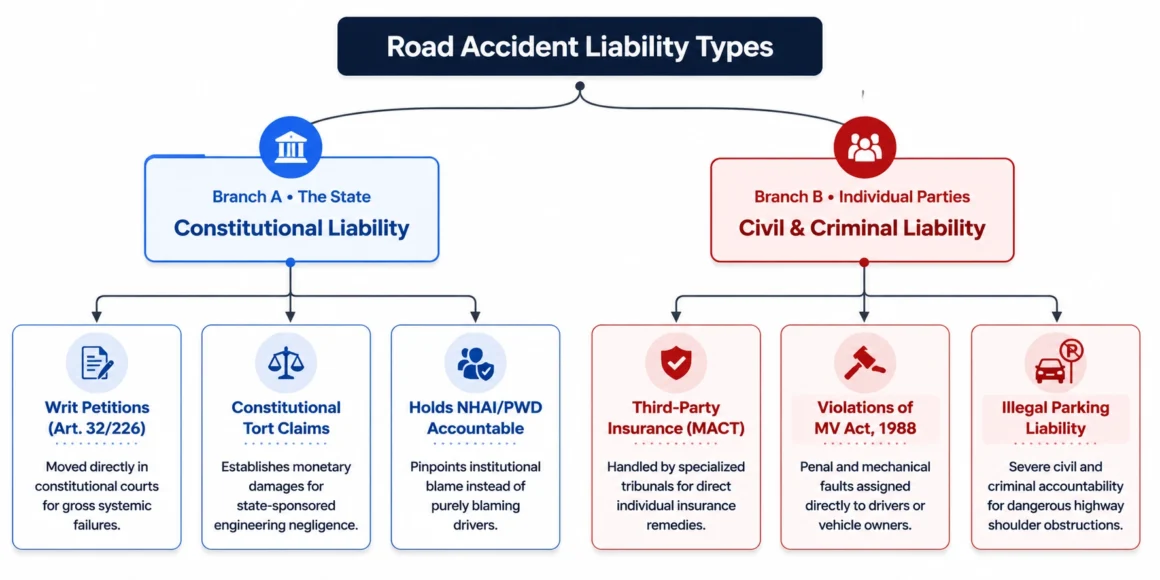
A. Action Against the Government (Constitutional Tort)
The recognition of safe travel as a fundamental right means infrastructure breakdowns are viewed as violations of Article 21 rather than simple mishaps.
-
- Writ Jurisdiction: Victims or their legal heirs can approach High Courts under Article 226 or the Supreme Court under Article 32 directly via Writ Petitions against public authorities like the NHAI or State PWDs.
-
- Public Law Compensation: If an accident is proven to be the direct result of an uncorrected engineering defect such as an unlit, known blackspot or a prolonged unscientific road cut, the courts can award damages against the State under the doctrine of constitutional tort.
B. Action Against Individual Parties (Statutory & Private Liability)
The ruling simultaneously tightens the screws on private individuals whose actions compromise public safety:
-
- Illegal Parking as a Strict Liability: The Court placed a strict prohibition on heavy commercial vehicles stopping on highway lanes or paved shoulders outside of designated bays. Owners and drivers of vehicles parked illegally face direct civil and criminal consequences if their vehicle causes a secondary collision.
-
- Commercial Land-Use Liability: Roadside businesses operating without explicit clearance from highway authorities inside safety zones face immediate demolition under Section 26 of the Control of National Highways (Land and Traffic) Act, 2002.
The Way Forward
The Supreme Court, identifying executive execution as the perennial weak point in road safety, utilized its unique authority under Article 142 to issue a sequence of obligatory, scheduled mandates aimed at upholding this right:
-
- Regional Responsibility: Establishing District Highway Safety Task Forces, co-chaired by the District Collector (DM) and the Superintendent of Police (SP). This initiative ensures that local leadership is held explicitly and legally liable for any safety deficiencies within their territory.
-
- Digital Oversight: Requiring the rapid implementation of Advanced Traffic Management Systems (ATMS) incorporating e-challans, intelligent cameras, and automatic speed sensors to eliminate human negligence from the enforcement process.
-
- Emergency Healthcare Infrastructure: Instituting a required system of Basic Life Support (BLS) ambulances stationed at 75 km intervals, guaranteeing that accident victims obtain essential medical attention during the vital Golden Hour.
Conclusion
The Phalodi Accident judgment represents a monumental shift in how we view public infrastructure. A citizen’s right to life is no longer paused the moment they step onto a public road. By translating systemic engineering failures into a violation of fundamental human dignity, the Supreme Court has handed citizens a powerful legal anchor to demand transparency, quality, and accountability from the state.